DENOMINATION OF ORIGIN VALDEPEÑAS
Tradition, territory and quality from the source
-
Valdepeñas DO
-
Technical Data Sheet
-
Climate
-
Soil
-
Grape Varieties
-
Viticultural Practices
-
Production Area
-
Vintage History
-
Organizational Chart
Valdepeñas Designation of Origin
The Valdepeñas Designation of Origin, located on the southern edge of the Southern Plateau in the province of Ciudad Real, is one of the oldest in Spain. It was officially recognized as early as 1932 in the Wine Statute, although its winemaking tradition dates back to the 3rd and 2nd centuries BC, as evidenced by the discovery of grape seed remains in the Archaeological Park of Cerro de las Cabezas, a purely Iberian settlement located near the Jabalón River, a tributary of the Guadiana.
A Millennia-Old Winemaking Tradition
The subsequent discovery in 2020 of two Roman wine presses in the Roman vicus of Consolación and in the Roman winery at El Peral provides evidence of an established winemaking tradition dating back at least 2,000 years, to the 1st century AD.
Production Area and Varietal Uniqueness
Today, Valdepeñas is a selective quality production area encompassing approximately 2,000 hectares of vineyards, carefully preserved by around 2,000 winegrowers. As a noteworthy fact, in 2004 a scientific study was published in which 225 Tempranillo clones from the Iberian Peninsula were analysed, concluding that this variety is found in its purest form in the Valdepeñas region, where it is known as Cencibel.
In this regard, Raimundo of Fitero, a Cistercian warrior-monk who took part in the defence of the Castle of Calatrava, is believed to have introduced this grape variety in the 12th century from his native Navarre, the probable area of origin of Tempranillo, which is thought to be a cross between the white variety Albillo Mayor and the red variety Benedicto, now at risk of extinction.
Historical Development and Recognition
The current Designation of Origin, which is the result of the historical expansion of its wines in the Madrid of the Austrian monarchs, was further strengthened by the opening of the Camino Real in 1761 and the arrival of the railway in 1861. Its first set of regulations was published in 1968 and currently covers vineyards in ten municipalities: Valdepeñas, Alcubillas, Moral de Calatrava, San Carlos del Valle, Santa Cruz de Mudela, Torrenueva, Torre de Juan Abad, Granátula de Calatrava, Alhambra and Montiel.
Prestige, Commercialisation and International Reach
A quality designation that evokes wine through sound, aroma and flavour, consistently ranking among the top five production areas in terms of spontaneous recognition and commercialisation. Proudly known as the wine of the “Austrian monarchs”, Valdepeñas wines occupied more than half of the stands at the 1877 Madrid Wine Exhibition and have been produced by commercial wineries since 1746.
They also attracted the attention of members of the nobility, including the Marquises of Santa Cruz and Mudela and the Count of Casavaliente, among others. Furthermore, Valdepeñas wines were the preferred choice of travellers such as Richard Ford and were enjoyed in the taverns of Madrid’s Cava Baja by renowned figures including Ava Gardner and Ernest Hemingway.
Climate, Soils and Wine Characteristics
Young wines, crianza, reserva and gran reserva wines from Valdepeñas, exported to more than 100 countries, benefit from a unique climate with low rainfall and extreme temperatures, as well as more than 2,500 hours of sunshine per year. These conditions, together with predominantly limestone soils and low yields per hectare, create the ideal environment for producing wines of outstanding quality, versatile enough to suit all palates and perfectly suited to pairing with a wide variety of dishes.
All of the above, combined with vineyard cultivation practices, shape the unique identity of this Designation of Origin.
Technical Sheet
Interprofessional Association of Valdepeñas Wines «INTERVALDEPEÑAS»
Date of recognition: 8 September 1932
Registered address: C/ Constitución, 23, 13300 Valdepeñas (Ciudad Real), Spain
Telephone: +34 926 32 27 88
Website: www.vinosvaldepenas.com · www.dovaldepenas.es
Email: dovaldepenas@dovaldepenas.es
President: Cristina Nieto García
Secretary: Esteban Saavedra
Altitude: 700 m above sea level
Authorised grape varieties:
White: Airén, Verdejo and Moscatel de grano menudo
Red: Tempranillo, Cabernet Sauvignon, Merlot and Syrah
Included municipalities:
Valdepeñas, Alcubillas, Moral de Calatrava, San Carlos del Valle,
Santa Cruz de Mudela, Torrenueva, part of Torre de Juan Abad,
Granátula de Calatrava, Alhambra and Montiel
Climate
The production area of the Valdepeñas Designation of Origin is located on the southern edge of the Southern Plateau, bordering the La Mancha plain to the north, Campo de Calatrava to the west, Campo de Montiel to the east and Sierra Morena to the south. The area is crossed from east to west by the Jabalón River, a tributary of the Guadiana. The average altitude in Valdepeñas is approximately 700 metres above sea level.
Climatic characteristics
These geographical conditions give rise to marked temperature variations, with extreme temperatures ranging from –10 °C in winter to 43 °C in summer. The climate is dry continental, with an average annual temperature of around 16 °C and low rainfall levels, between 200 and 400 millimetres per year.
Throughout the year, approximately 300 clear days and more than 2,500 hours of sunshine are recorded. These are key factors in grape ripening and in the production of wines with greater colour intensity, optimal structure and high aromatic potential.
Soil
The predominant soil types are low in organic matter and have limited fertility, making them particularly suitable for vine cultivation. Calcareous soils are widespread, locally known as calar soils, as well as iron-rich soils found in certain areas of the Jabalón River lowlands, referred to by local growers as rubial soils.
In some hillside areas, quartzite stones and gravel are common. These elements help retain moisture and directly influence grape ripening by reflecting heat onto the clusters.
Grape Varieties
The grape varieties authorised by the Valdepeñas Designation of Origin include the white variety Airén, known in some areas as valdepeñero, as well as Macabeo, Chardonnay, Verdejo, Sauvignon Blanc and Moscatel de grano menudo.
The authorised red varieties are Tempranillo — known locally as Cencibel and even referred to as Valdepeñas in several countries — Garnacha, Cabernet Sauvignon, Merlot, Syrah and Petit Verdot.
Viticultural Practices
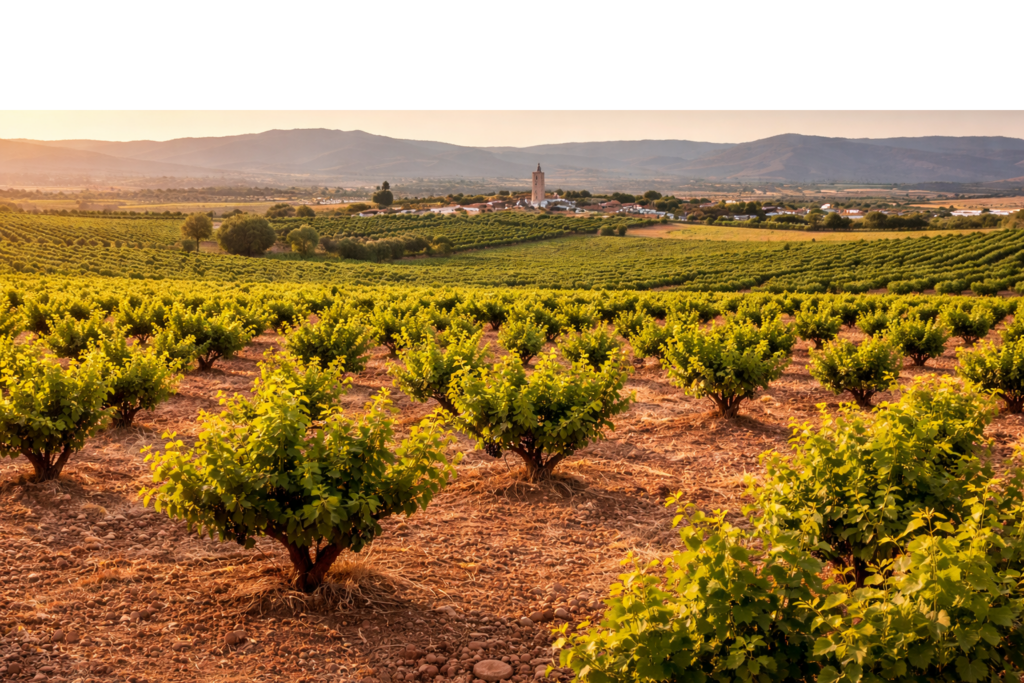
Another key factor influencing winemaking by territory is the set of techniques used in vineyard management throughout the year. These practices, passed down from generation to generation, help preserve tradition in woody crop cultivation and are distinguished by their high level of environmental respect and sustainability.
This is particularly significant given that vineyards represent the only green landscape across much of the production area of the Valdepeñas Designation of Origin.
Production Area
The current production area is the result of the expansion of the municipal boundaries of Valdepeñas towards 1841 and the growth of vineyard plantations following the ecclesiastical disentailments of the period. Today, it encompasses approximately 12,000 hectares of vineyards across ten municipalities: Valdepeñas, Alcubillas, Moral de Calatrava, San Carlos del Valle, Santa Cruz de Mudela, Torrenueva, Torre de Juan Abad, Granátula de Calatrava, Alhambra and Montiel.
Traditionally, protective measures have been established for this small and clearly defined production area. As a noteworthy fact, its grapes have historically enjoyed greater added value than those from other nearby locations and from the region as a whole.
Municipalities of the Designation of Origin
San Carlos del Valle
The origins of the town date back to the now-disappeared hermitage of Santa Elena, probably built in the 12th or 13th century. Until the 18th century, it remained little more than a place of worship, although one of its walls featured a painted image of the venerated (and miraculous) Christ later known as the Christ of the Valley.
During the 16th century, the first permanent settlement developed around the hermitage. The growing pilgrimages to pray to the Christ led the Crown and the Council of Military Orders to build a new hermitage.
Following the completion of the works during the reign of Philip V and a rapid increase in population, urban reorganisation became necessary. Later, in 1800, King Charles IV issued a Royal Charter of Privilege granting San Carlos del Valle independence and making it a municipality separate from Membrilla.
With a current population of around 1,200 inhabitants, one of its most famous residents is Manolo “el del Bombo”.
Alhambra
The present-day municipality of Alhambra, one of the largest in the province of Ciudad Real in terms of area and historical importance during the Middle Ages, includes the hamlet of Pozo de la Serna.
It is notable for its castle, built under Umayyad rule on the remains of an earlier Arab construction.
Within the town centre (near the church), remains from the Roman period are still preserved. Some historians locate here (or in its surroundings) the important Roman city of Laminium, mentioned in numerous classical sources.
Alcubillas
The earliest historical reference to Alcubillas dates back to 747, when the place name Alcoiellas appears on a map of the administrative division of provinces carried out by Muslim authorities.
In 1181, a papal bull issued by Pope Lucius III confirmed the donation of Alcubillas to the Order of Santiago by Alfonso VIII. In 1213, Alfonso VIII granted the Order of Santiago possession of all the towns of the Campo de Montiel. In 1223, Pope Honorius III confirmed Christian possession of Alcubillas through another papal bull.
In 1243, following a dispute between the Order of Santiago and the Archbishop of Toledo, King Ferdinand III granted the Order of Santiago ownership of the church of Alcubillas.
In 1275, Alcubillas and other nearby villages were assigned as dependent settlements of Montiel, under the Master of the Order Gonzalo Ruiz.
In 1539, Alcubillas was granted the status of a town, becoming independent from Montiel and incorporated into the Royal Crown and Patrimony after paying 520,000 maravedís to the Royal Treasury.
In 1624, King Philip IV passed through Alcubillas accompanied by his brother, the Infante Don Carlos, his Prime Minister the Count-Duke of Olivares, and the renowned writer Francisco de Quevedo, among others.
In 1809, during the War of Independence, the people of Alcubillas fought heroically against Napoleon’s troops, supported by Captain Rosales and the carabineer Juan Molina of the Granada Dragoons Regiment.
As a curiosity, Alcubillas reached the final of the first edition of El Pueblo más Divertido de España (TVE) in 2014. Since 2013, it has also maintained the tradition of parodying Spain’s National Christmas Lottery advertisement.
Montiel
The origin of the place name Montiel is Mozarabic and gives its name to the entire region of Campo de Montiel, already mentioned in Don Quixote. Montiel was the scene of a military confrontation during the Hundred Years’ War and its associated conflict, the Castilian Civil War: the Battle of Montiel.
In this battle, Franco-Castilian forces confronted a Granada-allied army. The former, commanded by Enrique de Trastámara (later King Henry II of Castile), defeated the latter, led by his brother Pedro the Cruel.
Torre de Juan Abad
Juan Abad, after whom the town is named, is believed to have been one of its earliest settlers during the Middle Ages. Torre de Juan Abad belonged to the Order of Santiago and was dependent on Montiel.
Francisco de Quevedo was lord of the town and hosted King Philip IV of Spain in his residence. During the 17th century, the municipal boundaries were separated from Castellar de Santiago and Torrenueva.
Today, with a population of around 1,000 inhabitants, Torre de Juan Abad is known for its organ concert cycles, a national and international reference, and for the International Conferences on Quevedo organised biennially by the Francisco de Quevedo Foundation.
Torrenueva
Torrenueva has historically belonged to the Order of Santiago. Two key dates mark its history. The first is 1275, when the Major Encomienda of Castile was created, encompassing the territory that would later form the town of Torrenueva. Although the town had not yet been formally established, its lands and the Dehesa de los Hitos were under the jurisdiction of Torre de Juan Abad.
The second key date is 1440, when Torrenueva was granted its Town Charter. This privilege was later confirmed by King Charles I on 2 June 1527, following its original grant by Don Enrique, Infante of Aragon.
In 1513, shortly after the discovery of America, several residents of Torrenueva travelled to the New World, including Juan Ruiz de Villamanrique, son of Juan Ruiz and María Moreno, both natives of Torrenueva.
Santa Cruz de Mudela
The title of Santa Cruz de Mudela originated in the first half of the 13th century. The various accounts of its origin combine historical facts, tradition and legend.
Oral tradition has passed down the meaning of the cross associated with the Battle of Las Navas de Tolosa in 1212. Other sources suggest it symbolised a crossroads enclave located in the Dehesa de Mudela, near the Muradal Pass, one of the gateways to the Meseta from Andalusia.
In 1462, the Encomienda of Mudela was expanded to include the town of El Viso. It remained under the authority of the commanders of the Order of Calatrava until shortly after the conquest of Granada by the Catholic Monarchs. It later became part of the head of the Marquisate of Santa Cruz.
On 30 January 1538, Don Álvaro “the Elder” purchased the towns of Santa Cruz de Mudela and Viso del Puerto (Muradal) from King Charles I. His son, Don Álvaro de Bazán “the Younger”, first Marquis of Santa Cruz, later built the palace and the Capuchin Franciscan convent.
Moral de Calatrava
The area where Moral de Calatrava now stands is believed to have been inhabited during the Middle Paleolithic period, as evidenced by various objects found near the Cueva de la Mora. There was later a Roman fishermen’s settlement near the Jabalón River, known as Oreto, from which valuable remains are still preserved.
Between 1535 and 1544, the Encomienda of Moral was created, one of several encomiendas established in Campo de Calatrava to replace those of Acea and Otos, whose assets had been incorporated into the Royal Site of Aranjuez.
By royal decree dated 10 June 1646, King Philip IV of Spain granted Moral de Calatrava jurisdiction of First Instance.
In the 18th century, Moral de Calatrava experienced significant economic development due to the production of vegetables and horticultural products, as well as the natural shelter provided by its surrounding hills. Wine production was estimated at 15,000 arrobas, and olive oil production at 30,000.
On Wednesday, 15 February 1895, Moral de Calatrava was proclaimed a city by Queen Regent María Cristina.
In the first half of the 20th century, the town experienced a major period of agricultural and industrial growth (wineries and olive mills), along with a demographic boom, largely driven by the arrival of the railway (the so-called trenillo del Moral), whose tracks extended directly to the wineries.
Granátula de Calatrava
Granátula de Calatrava is characterised by volcanoes of magmatic origin (the cones of Columba, Cuevas Negras or La Yozosa) or phreatomagmatic origin, which gave rise to lagoons such as the crater that contains the urban centre, Valdeleón, with a diameter of more than 2 km. Although in the year 2000 the geyser known as the “Chorro de Granátula” appeared, it is currently extinct, with the exception of La Fumarola, which is still active in La Sima.
In the surroundings of Granátula, two very important archaeological sites can be visited: La Encantada, a Bronze Age hilltop settlement (a “castellón”), with defensive walls, dwellings and silos, and home to a cave associated with the legend of a lizard or snake that turns into La Trocanta or Encantá on the night of Saint John; and the site of Oreto y Zuqueca, with remains dating from pre-Roman times through to the Middle Ages.
Here stands the house where the general and politician Baldomero Espartero was born in 1793, as well as his equestrian statue. In addition, the first scene of Pedro Almodóvar’s film Volver was filmed in this town, along with traditional games and rural agricultural work from La Mancha.
Valdepeñas
From the first millennium BC onwards, settlement began to spread in what is now known as Valdepeñas. It was during this period that the Iberian settlement of Cerro de las Cabezas was established, dating from the 7th to the 3rd centuries BC.
From the 15th century onwards, Valdepeñas experienced a considerable increase in population, and the Encomienda of Valdepeñas is mentioned for the first time during the time of the 25th Master of the Order of Calatrava.
King Philip II sold the town to the Marquis of Santa Cruz. To that end, the monarch issued a royal decree on 21 May 1582, by which the town ceased to belong to the Order of Calatrava and was sold to Don Álvaro de Bazán for 104,985 reales and 8 maravedís.
During the 16th and 17th centuries, notable citizens of Valdepeñas set out on the adventure of the New Continent, including the well-known epic poet Bernardo de Balbuena and members of the Merlo lineage, who took an active part in the conquest of the New World.
However, the most outstanding historical event in our city — a prelude to the Battle of Bailén and a reflection of the romantic spirit of its time — took place on 6 June 1808. On that day, the people of Valdepeñas offered strong resistance to Napoleonic troops commanded by General Ligier-Belair.
This feat earned Valdepeñas the title of “Muy Heroica Ciudad” on 29 January 1885.
Falta
Presidenta
Cristina Nieto García
ASEVIVALDEPEÑAS
Junta Directiva
Vicepresidente
Antonio Torres Pérez
ASAJA
Secretario
Esteban Saavedra Márquez
Upa CLM
Tesorero
José González-Albo Morales
ASEVIVALDEPEÑAS
Vocalías
Vocal
Cecilio Moreno Sánchez Barba
ASAJA
Vocal
Carlos Nieto Sepúlveda
ASEVIVALDEPEÑAS
Vocal
Luciano José Farcía-Carrión Corujo
AVIVAL
Vocal
Juan Antonio Mejía
Cooperativas Agro-alimentarias CLM
Vocal
José Vicente Montoya Sánchez
COAG
Vocal
José Manuel Corrales Carrero
Asociación de Pequeños Productores
Valdepeñas Designation of Origin
The Valdepeñas Designation of Origin is located in the south of the province of Ciudad Real, in the heart of Castilla-La Mancha, and is one of Spain’s historic wine-producing regions.
Its winemaking tradition, together with extreme climatic conditions and the uniqueness of its soils, has given rise to wines with a strong identity, recognised for their balance, colour intensity and aromatic richness.
This section presents the main factors that define the character of Valdepeñas DO wines: climate, soils, authorised grape varieties, viticultural practices and the delimitation of the production area.